

Preparing Students to Lead in an AI-Enabled Future
At Georgia Tech, we believe every student should graduate prepared to use artificial intelligence (AI) effectively, thoughtfully, and responsibly. Built on years of leadership in AI research, education, and innovation, Georgia Tech's Academic AI Strategy provides a framework for advancing teaching and learning in the AI era. The strategy supports faculty-led innovation while preparing students for a future in which AI will play an increasingly important role across professions, industries, and society.
Strategic Goals
The Academic AI Strategy is organized around three goals:
Goal 1: AI Fluency for Every Student
Ensure every Georgia Tech graduate knows how to use AI effectively, thoughtfully, and responsibly.
Goal 2: AI Innovation Across the Academic Enterprise
Equip faculty, staff, and students to build and integrate AI tools effectively and responsibly across teaching, learning, research, and service.
Goal 3: Institutional Leadership and Engagement
Strengthen Georgia Tech's impact through aligned external engagement and a clear, consistent articulation of the Institute's AI expertise and capabilities.
Academic Freedom Remains Central
Georgia Tech's Academic AI Strategy is grounded in the Institute's longstanding commitment to academic freedom, shared governance, and faculty leadership. Faculty retain primary responsibility for curriculum, instruction, assessment, research, and the maintenance of academic standards.
The strategy provides a framework for exploring opportunities, sharing resources, and supporting innovation across the academic enterprise. It is intended to empower faculty, not prescribe how AI should be used in teaching, learning, or research. Implementation will occur through established governance structures and processes, with faculty expertise continuing to guide decisions affecting the academic mission.
Build Your AI Fluency
Access training, prompt libraries, workshops, and guidance for Microsoft Copilot, Gemini, ChatGPT Edu, and other approved AI tools at Georgia Tech.
Learn how to use Microsoft Copilot at Georgia Tech through training videos, prompt examples, workshops, and practical guidance for working with Institute data.
Google for Education at Georgia Tech
Explore a central hub for Gemini for Education, NotebookLM, AI guidance, training resources, frequently asked questions, and best practices for the Georgia Tech community.
This resource supports faculty, staff, and students with access to ChatGPT Edu, practical prompt libraries, training resources, feature guides, and data governance guidance for responsible AI use.

Academic AI Strategy Leadership: David Joyner
Interim Vice Provost for AI in Education
David Joyner serves as Interim Vice Provost for AI in Education at Georgia Tech, where he leads implementation of the Institute's Academic AI Strategy. Building on a collaborative, faculty-led planning process, he works with faculty, academic leaders, and campus partners to advance AI-driven innovation in teaching and learning across the academic enterprise.
Joyner also serves as Executive Director of Online Education and OMSCS in the College of Computing. A recognized leader in educational technology, online learning, and AI-enabled education, his work focuses on learning at scale, student success, instructional innovation, and the responsible integration of technology into the academic experience.
As Interim Vice Provost, Joyner works collaboratively with faculty, staff, and students to expand AI fluency, support innovation in teaching and learning, coordinate implementation efforts, and advance Georgia Tech's vision for responsible AI in higher education.
How the Strategy Took Shape
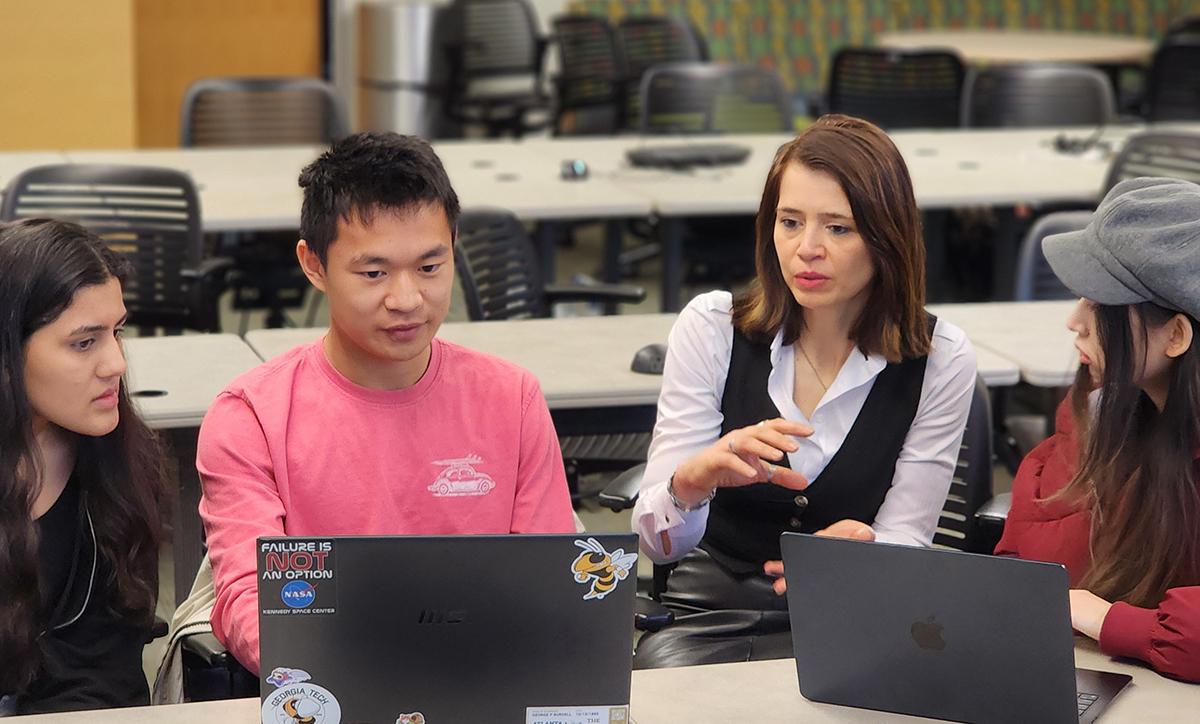
Faculty, staff, students, and academic leaders from across Georgia Tech shaped the Academic AI Strategy through a collaborative, faculty-led process. Guided by Provost Raheem Beyah and supported by Larry Jacobs, Leo Howell, the Provost's AI Advisory Committee, AI and Learning at Georgia Tech initiative workgroups, and Georgia Tech Strategic Consulting, contributors from across the Institute developed a shared framework for advancing teaching, learning, research, and service in the age of AI.
Workgroup Leads
- AI for Learning and Instruction: Matthieu Bloch, College of Engineering
- AI Outside the Walls of Georgia Tech: Lizanne DeStefano, College of Lifetime Learning
- Computing Infrastructure: Leo Howell, OIT
- AI in the Classroom: David Joyner, College of Computing and Office of the Provost
- AI and Our Student Body: Rocio Perales Valdes, Student Representative
Guiding Principles
We are intentional about how we develop, evaluate, and use AI in teaching, learning, research, and service. Our approach is grounded in the principles below that guide decision-making across the academic enterprise.
- Human-Centered: AI should enhance human creativity, judgment, and learning.
- Responsible: AI should be fair, transparent, safe, ethical, and accountable.
- AI-Fluent Students: Every student should understand how to use AI effectively and responsibly.
- Faculty-Empowering: AI should support faculty innovation while preserving academic freedom.
- Innovative: We will experiment, learn, and continuously improve.
- Future-Ready: We will adapt and lead in a rapidly changing AI landscape.
- Access and Participation: AI should expand opportunity and reduce barriers.
- Public Good: AI should create positive impact for communities, industries, and society.
Academic AI Playbook
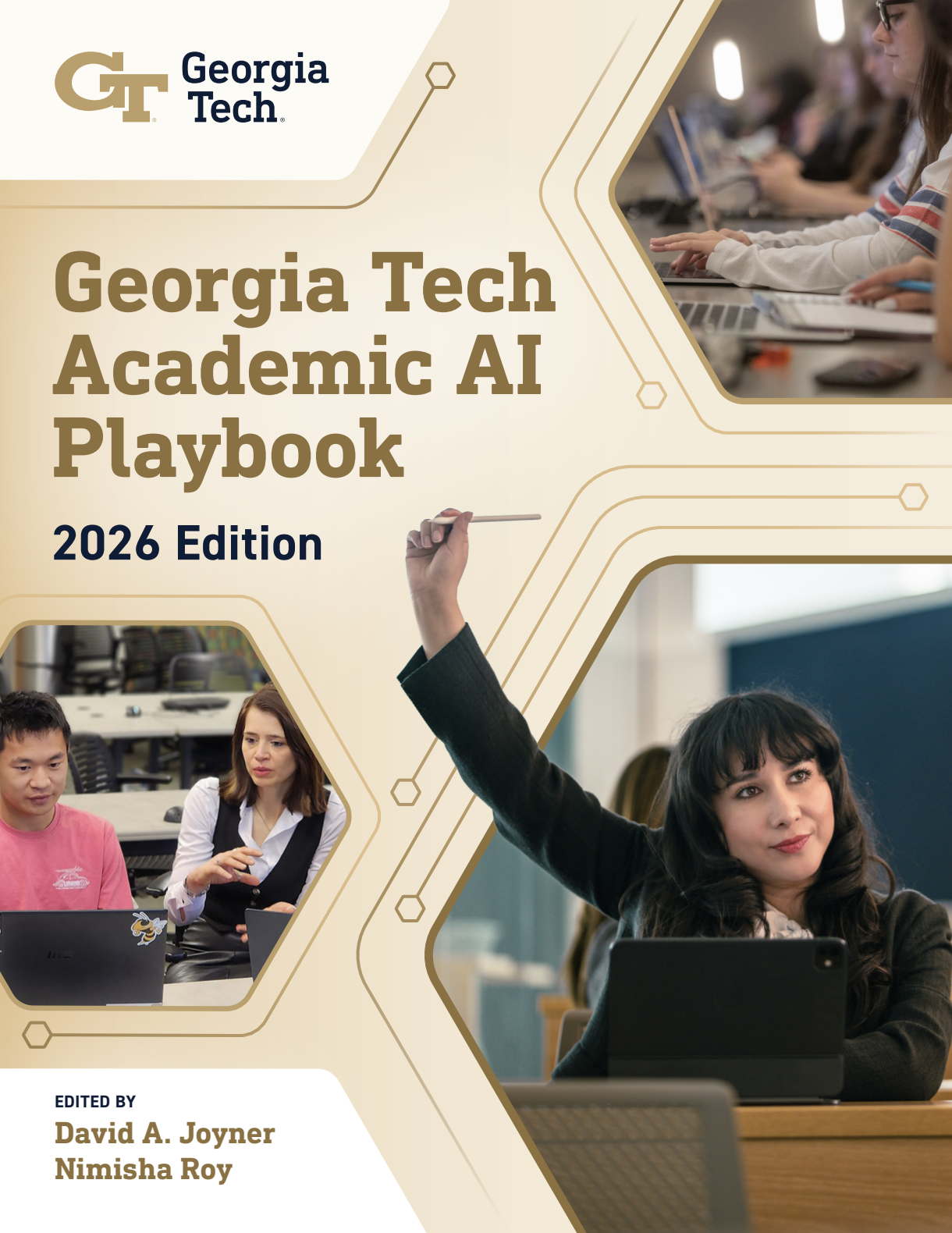
The first edition of the playbook features 67 faculty-authored articles representing every College at Georgia Tech, along with 20 lessons drawn from classroom experience. The collection includes examples of faculty using AI to support instruction, teaching students how AI is shaping their fields, and redesigning assignments and learning experiences for an increasingly AI-enabled world. Together, the articles provide practical, discipline-specific insights that faculty can adapt to their own teaching contexts.
Policy Library: Interim Policy on AI in Academic and Research Contexts
Effective June 2026, this administrative policy, jointly owned by the Office of the Provost and the Office of the Executive Vice President for Research, establishes Georgia Tech's framework for the responsible use of AI in academic and research settings.
The policy affirms the Institute’s commitment to providing access to AI technologies while ensuring they are used ethically, responsibly, and securely.
The policy applies to faculty, researchers, staff, students, affiliates, and other Georgia Tech community members and outlines governance for AI use in academic and research contexts.
Resources
AI@Georgia Tech: Explore Georgia Tech's AI research, partnerships, education programs, events, and Institute-wide initiatives.
OIT AI Resources: Access approved AI tools, training opportunities, guidance, and technical resources.
Institutional AI Register: Explore Georgia Tech's approved AI tools, review data use guidelines, and understand the security and privacy requirements that support responsible AI use across the Institute.
AI Across Georgia Tech
AI Academic Programs: Georgia Tech offers world-class, cutting-edge degree programs designed to equip students with the knowledge, skills, and experience necessary to become leaders in the rapidly evolving field of AI.
AI Makerspace (NVIDIA Partnership): By giving students access to advanced AI computing resources, the AI Makerspace provides hands-on learning opportunities that prepare students to lead in an AI-enabled future.
AI4Science: The AI4Science Center advances interdisciplinary research and scientific discovery through artificial intelligence and machine learning.
Center for AI in Business: The Scheller College of Business prepares students and organizations for AI-driven transformation through applied research, education, and industry engagement.
NSF AI Institutes: Through Tech AI, Georgia Tech helps lead a portfolio of National Science Foundation AI institutes focused on advancing artificial intelligence research, education, and workforce development. Together, these institutes demonstrate Georgia Tech's leadership in applying AI to challenges ranging from learning and health care to cybersecurity, optimization, and scientific discovery.